
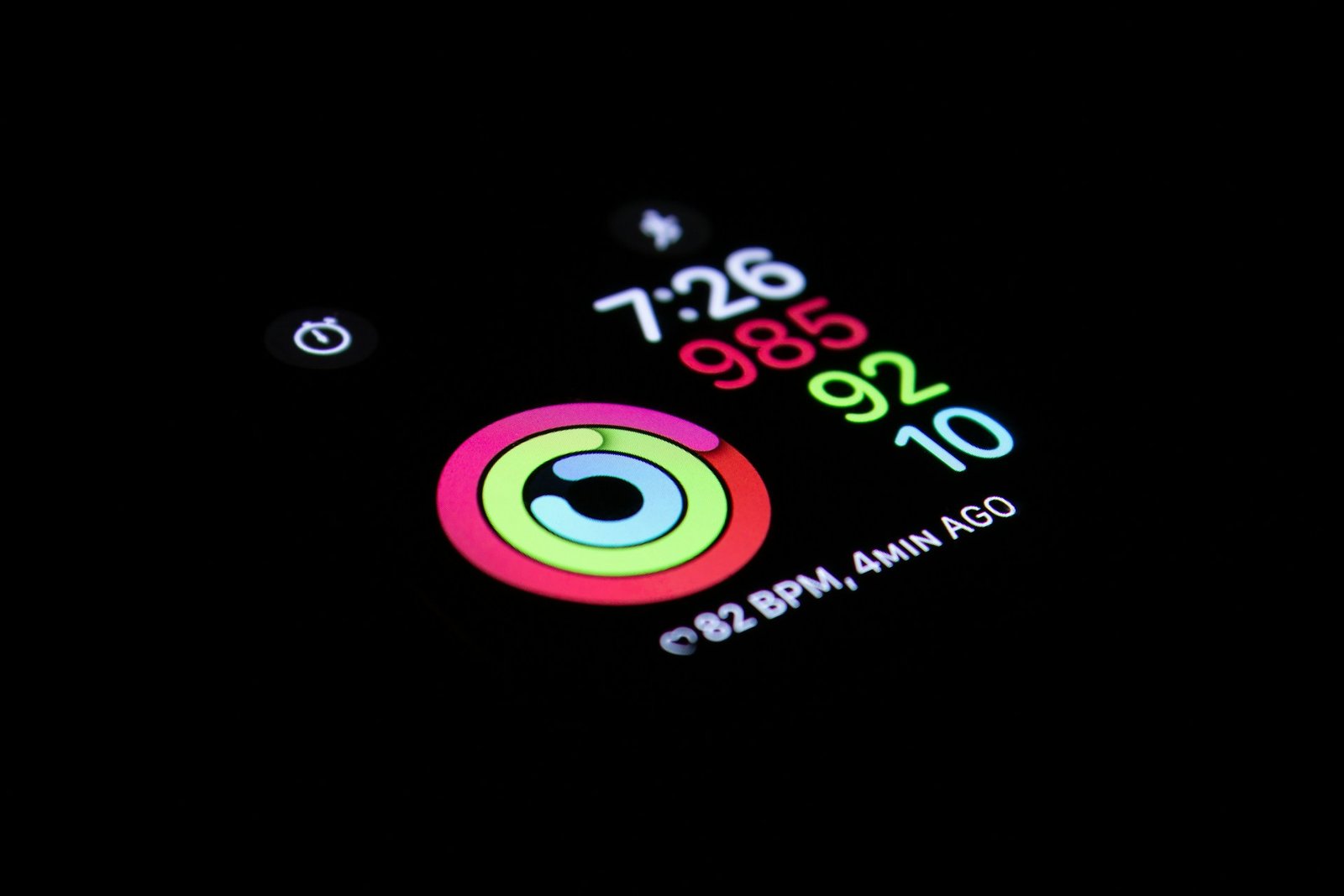
I can’t remember the last time I went out for a run without my phone, music, or watch. I’ve forgotten what it would be like to not track distance, heart rate, or my running pace. I’m not sure I could stand running five miles without a podcast or music, with just my own thoughts for company.
I know why I sort of dread that prospect. Does the run count if there was no record of it? If I couldn’t see the splits or record the data, would I be satisfied with just the experience?
This is mildly horrifying when you stop to look at it. Somewhere over the last decade, most of what we do has quietly become raw material. Data points from which content can be extracted.
Our modern-day devices—smartwatches, smartphones, smart rings—are all built to count. You say you traveled? Where are the pictures? You said you didn’t sleep too well? Where’s the sleep debt report?
We are more interested in capturing pictures of the pretty sunset on our phones (for posterity) rather than letting awe wash over us fleetingly. The truth is, we started paying attention to these because the algorithms have convinced us that the data will make our lives better. They have a point. It’s in my interest to track my run distance and pace to see if I’m making progress over time. Similarly, explicit scolding from your tracker about your sleep may be what finally pushes you to turn off Netflix at 2 a.m.
But there are things the algorithm misses.
It misses imperfection. There’s a Japanese aesthetic called wabi-sabi: the beauty of the chipped bowl, the unswept leaf, the cherry tree shaken over the otherwise flawless garden. According to legend, the young apprentice Sen no Rikyu raked his master’s tea garden to perfection, then deliberately knocked Sakura petals onto the path before presenting his work. A garden without them was, somehow, less of a garden.
Our algorithms don’t like chipped bowls. They want the bowl photoshopped, lit, and sharpened. But the chipped bowl is the one we love. Adam Grant, in Hidden Potential, calls wabi-sabi a character skill — the discipline to shift our attention from impossible ideals to achievable standards, and then adjust those standards as we go. It is the opposite of the curated feed.
It misses real disagreement. Charles Darwin sat on his theory of evolution for nearly twenty years before publishing it. He told a friend it felt “like confessing a murder.” We don’t have time for twenty-year opinions. Our algorithms reward strong opinions held lightly. The genuinely contrarian thinker — the one who’d rather be right slowly than wrong quickly — is invisible to it.
Naval Ravikant has a useful definition: a contrarian is not someone who always objects (that, he says, is a conformist of a different sort), but someone who reasons independently, from the ground up, and resists pressure to conform. The algorithm has no patience for that kind of person. It prefers a louder, faster simulation of disagreement, where everyone takes a side and no one changes their mind.
It misses kindness in private. Sometime in the early 1990s, a team of neuroscientists at the University of Parma in Italy noticed something strange. A monkey’s brain lit up not only when it reached for an ice cream cone, but when it watched a researcher do the same. Mirror neurons, they called them. We have them too. They are a lot of why we feel another person’s joy, sorrow, fear. They are how empathy gets installed.
The catch is that mirror neurons require presence. They don’t fire well over screens. Which may be why, when we are anonymous and disembodied online, the kinder parts of us grow strangely quiet. Psychologists call this the online disinhibition effect — our tendency to say things to a username we’d never say to a face. In 2023, the U.S. Surgeon General’s advisory called loneliness and disconnection a public health emergency on the order of smoking. The underlying meta-analysis by Julianne Holt-Lunstad and her colleagues looked at more than 300,000 people and found that weak social ties raise mortality risk roughly as much as fifteen cigarettes a day. The algorithm can connect us, sort of. It cannot do the part where we look at a face and feel something. We have to be in the room.
It misses the slow ones. The Harvard Study of Adult Development has been following the same group of men (and now their families) since 1938 — the longest study of human happiness ever conducted. The clearest finding, almost insultingly simple, is this: the people who do best are the ones with strong, warm relationships. Not money. Not fame. Not even physical health, exactly. Connection — the slow, untraceable kind — is what predicts a good life.
Most of what makes a life is slow: a good marriage, grip strength, lasting friendships. But the process to get here is unglamorous, and barely perceptible. A Tuesday morning strength training session, or a regular coffee catch up with a friend, barely registers on the algorithm. It neither performs, nor posts well.
It misses solitude. The algorithm cannot survive without your attention. So it has trained us, very effectively, to be comfortable when no one has it.
A widely cited 2014 study led by Timothy Wilson at the University of Virginia found that many participants, given the choice between sitting quietly with their thoughts for fifteen minutes or administering themselves a mild electric shock, chose the shock. We will literally hurt ourselves to avoid being alone with ourselves.
It is, I think, the strangest evidence of how successfully we’ve been pulled away from our own company. Picasso said that without great solitude, no serious work can be done. He may have been talking about painting. He might just as easily have been talking about the much more ordinary work of becoming a person.
***
Let’s try to reclaim a little of our lives from the algorithms. One thing every day that nobody knows we did. A run with no watch. A cup of coffee on the porch with no podcast. A small act of kindness that goes unposted. The occasional unswept leaf.
The untracked life isn’t smaller. It’s probably where most of it was supposed to happen all along.