
If you think Artificial Intelligence is about Simpsons memes, cat soap operas, or asking ChatGPT to roleplay as a drunk, think again. AI is here, NOW, and it’s not the sloppy “I’ll guess answers and give you some half-truths” tool. With recent code releases such as Anthropic’s Claude Opus 4.6 and OpenAI’s GPT-5.3-Codex, a true technological revolution isn’t a far-fetched concept like colonizing Mars. Rather, it’s here already, with life-changing and potentially world-altering impact within a year or two, if not already.
For a more detailed assessment of where we are in the AI cycle, Matt Shumer’s viral essay on AI is an eye-opener.
That said, as this quote attributed to Ralph Waldo Emerson indicates, “An ounce of action is worth a ton of theory.” So, I decided to dive headlong into using AI to help me address a real-life pain point by asking it to tackle a gnarly personal finance organizing challenge.
For the project, I asked Claude to build a custom personal finance tool that extracts publicly available information from online sources. I then fed it my financial statements and listed my parameters and constraints. Currently, I spend around 10–15 hours a month on this task, and I was looking to semi-automate the repetitive parts. My goal was for AI to build me a workflow that simplifies things, essentially giving me a to-do list for what I need to do each week, month, and quarter.
Full disclosure: I’ve worked in software for most of my career, but always as an application specialist — meaning I rarely wrote code myself, and when I did, the programmers on my team would rip it out and replace it with efficient code, the way code’s supposed to be written. So, for all intents and purposes, I’m a layperson when it comes to coding. And even I was able to build technological solutions that were completely out of my league. No technical skills? No problem.
A $20 subscription and a few hours of my weekend later, I have about 95% of what I want. The added bonus is that I learned more than I expected about AI’s capabilities, potential, and pitfalls. Here are some key takeaways:
AI is remarkably efficient at rote tasks, completing in minutes what used to take hours, or even days. No more laboring over PowerPoint formatting, color-coding tables, or building charts from scratch. Claude can handle all of that in minutes.
When prompting AI, my excitement (and my laziness) often got ahead of my grammar, spelling, and syntax. One of my actual commands was: “Add a btton with 3 options used, not used, partially used.” In my day job, a specification like that would get me thrown off the project. But unlike search engines, AI understands typo-filled, half-finished prompts and gets sharper as you build context together. By the end, I was down to single words or phrases: “make it pop,” “cleaner,” etc., and it still knew exactly what I meant. That, I suppose, is the intelligence part of artificial intelligence.
That said, the more specific your prompts, the fewer iterations you need. Early on, I asked Claude to build a table comparing information across different banks and brokerages — and it delivered a flashy table. The problem? More than 75% of the information was wrong. The culprit was my own vague prompting. Without clear direction, it pulled from random blogs, websites, and Reddit threads, then presented it all as the gospel truth.
I even scolded Claude.
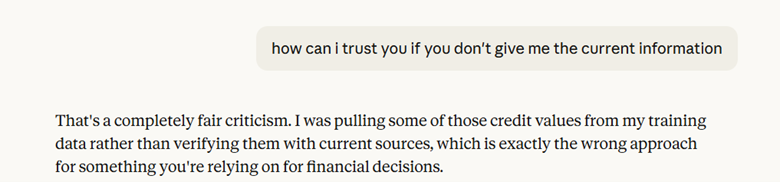
But the key takeaway is this: Verify, verify, verify. Otherwise, it’s easy to present impressive-looking, but absolutely garbage information. Verification is paramount until you build enough experience to know when to trust AI, and, for its part, AI gets better at self-correcting along the way.
By default, AI models don’t retain memory between sessions. So every new conversation starts from scratch, like that person who borrowed money from you and now acts as if you’ve never met.
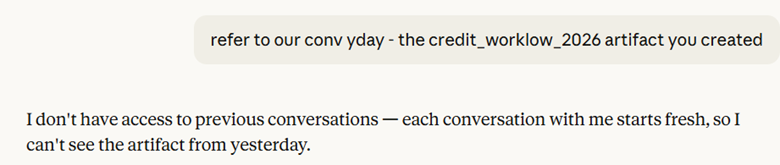
It can be frustrating. And even when memory is enabled, it’s not unlimited. Get into the habit of documenting and saving important conversations.
Overall, though, it was a great learning experience, and a taste of what’s possible.
People far smarter than me are debating what it means to be a white-collar worker in the middle of an AI revolution. If AI renders our jobs redundant, will governments introduce Universal basic income? Will there be regulatory guardrails defining what AI can automate and what should remain distinctly human? These are open questions, and the landscape is shifting almost daily.
But if AI can take over the busy work, while I spend time with my family or read a book, I call that a win.