
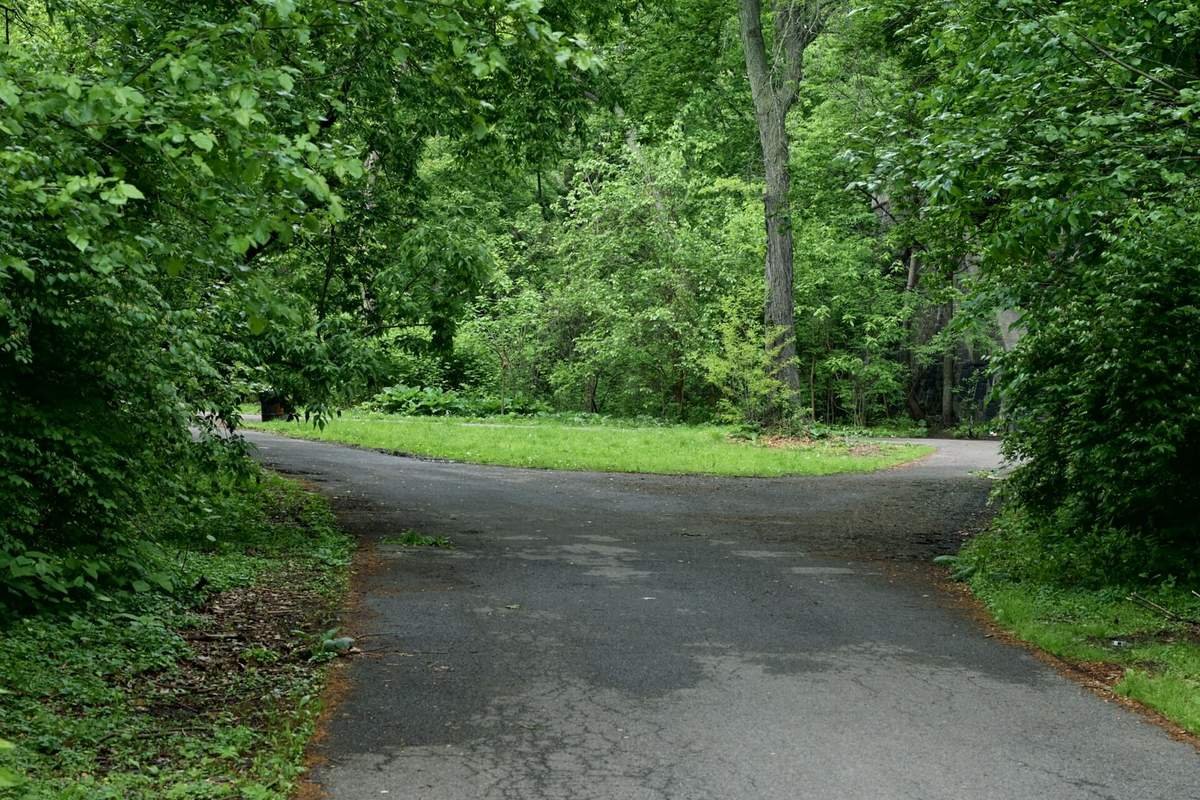
In August 1915, The Atlantic Monthly published a short poem by Robert Frost called The Road Not Taken. In the hundred-plus years since, it has appeared on coffee mugs, refrigerator magnets, and in most graduation speeches on record. It is also, according to the Paris Review, the most misread poem in America. We quote it as an anthem of bold individualism, even though Frost plainly says the two roads were worn “really about the same” and “equally lay / In leaves no step had trodden black.” Neither road was actually less traveled.
Frost wrote it as a joke. His closest friend in England, the writer Edward Thomas, took long walks with him through the countryside, and at every fork Thomas agonized over which path to take, then spent the rest of the walk mourning the one they skipped. Frost described him as “a person who, whichever road he went, would be sorry he didn’t go the other.” He mailed Thomas an advance copy, expecting a laugh.
Thomas took the poem seriously and personally. His biographer believes it weighed on his decision to finally enlist in the Great War, a choice he had been circling for months. He was killed at Arras in 1917.
I get Thomas. I would be no fun on those walks either.
Indecision is where I’ve spent a lot of my waking hours, even though I was warned when I was six about its pitfalls through the story of a donkey. Here’s the condensed version of that story: a donkey stood equidistant between water and hay, unable to pick either, until other donkeys drank the water and ate the hay and the indecisive donkey died of starvation.
Sylvia Plath’s fig tree, where every wonderful future withers while we sit in the branches, unable to commit because limitless choices come with limited time, is a more refined example of why we should decide soon.
I still spend days negotiating with myself over when and what to write, and soon it’s 7 p.m., and I’m completely wiped out with nothing written.
Indecision can be costly.
The 2008 financial crisis ran this experiment at scale. The investors who decided early and stuck with it, whether they held on or cut their losses and ran, ended up fine, or at least finished. The dawdlers, who reopened the decision whenever the market lurched, sold at the bottom and fared the worst of all. Their hemming and hawing proved to be the most expensive strategy of the lot.
The research on this is humbling. Barry Schwartz found that maximizers, the shoppers determined to wring the best possible outcome from every decision, end up less happy and more prone to regret than the ones who settle for good enough.
My favorite is a study by psychologists Daniel Gilbert and Jane Ebert, who gave photography students a print to keep. Half were allowed to swap it for a different one later; half were stuck with their pick. Nearly everyone wanted the swap option. But the students who could not change their minds ended up liking their prints more. There’s something to be said about closed doors.
That said, it’s not hard to adapt to making quick decisions. Researchers estimate that around 43 percent of what we do each day happens in the same place, in the same way. Looking back, they were decisions, too, made once by an earlier version of us and never questioned. That’s why building habits becomes important: it removes an action from negotiation.
According to experts, here are five small places to start making quick decisions
Set a thirty-second timer for the small stuff
Dinner, outfit, what to watch: pick before the timer goes off, or flip a coin and obey it. These choices will not matter in a week, so the downsides are non-existent.
Run the five-year test on the bigger stuff
Will this matter five years from now? If no, just make a decision today. If yes, put a real deadline on the calendar anyway.
Shortlist to three, then choose
Choice overload is half the problem. Skip evaluating all twenty-four jams; pick three finalists fast and compare only those.
Aim for good enough
If an option covers 80 percent of what we need, take it. Chasing the perfect choice reliably makes us less happy than settling well.
Decide once, then automate
For anything recurring, like the coffee order or the creative hour, make the decision one time and turn it into a routine. In other words, a decision once, not every day.
I’m trying to start small. My coffee order used to be a saga: flat white or Americano, skimmed or plant-based milk, dark or medium roast. I now order the same drink every time. When I find myself hemming and hawing over something, I’ve taught myself to set a timer to pick one thing.
Yes, there’s hope for us ditherers.
A person who, whichever road he went, would be sorry he didn’t go the other. Robert Frost, describing the friend who inspired “The Road Not Taken,” 1915