
In 1974, Andy Warhol started filling cardboard boxes with the odds and ends of his life. In his 1975 book, he made it sound like a system: “What you should do is get a box for a month, and drop everything in it and at the end of the month lock it up.” By the time he died in 1987, he had filled more than 610 boxes with ticket stubs, unpaid bills, a still-inflated Batman toy, a pair of Clark Gable’s shoes, and some pizza dough. Today they belong to the Andy Warhol Museum in Pittsburgh.
Unlike Warhol, there won’t be a museum waiting for our boxes. At most, we may have a drawer, closet, or a garage.
We hold on to things even when it costs us something, because letting go feels hard. But almost always, once we can let stuff go, it rarely feels like a loss.
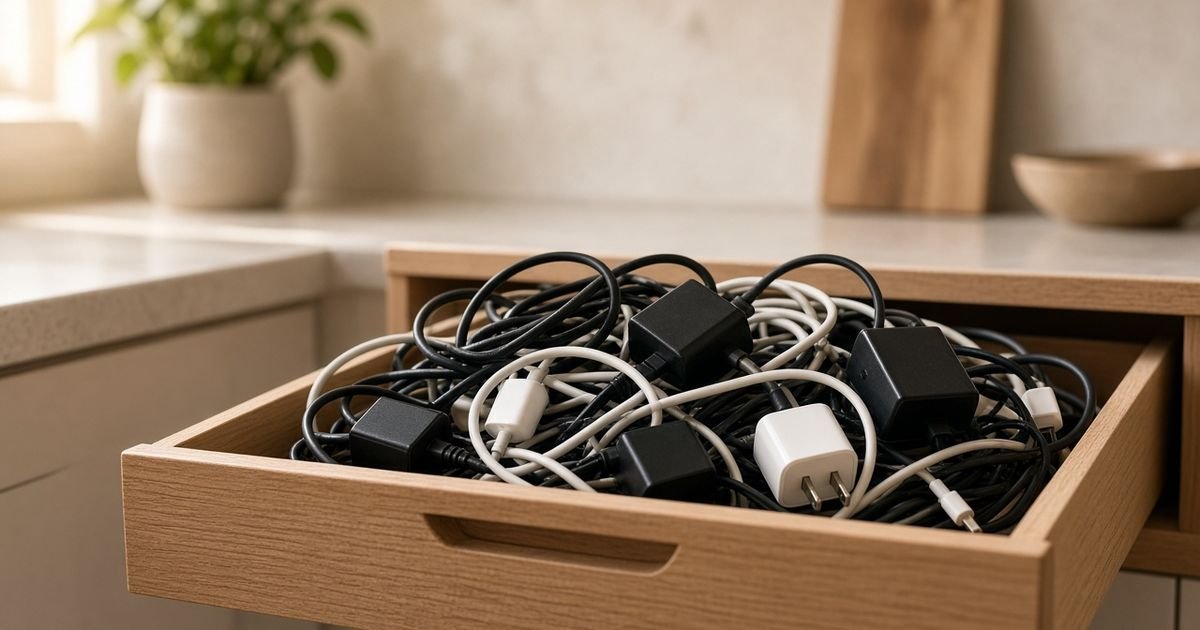
I have a box with cords for phones nobody owns anymore, a charger that fits nothing, and one mystery cable I’m afraid to throw out because it’s probably important. I haven’t needed to open this box for years. I still keep it because I fear a device from 2011 might someday rise from the dead and need power.
A few years ago, I wrote about how we treat our possessions like royal babies, keeping an heir and a spare of everything. Our rationale is simple: just in case. I wish I could say I’ve transcended to a higher plane (when it comes to hoarding stuff) after writing that piece. Nowhere close.
Not for lack of trying. I set a standing declutter habit on my calendar twice a week. So far, I’ve mostly just moved the appointments to the following week. Rarely, when I’ve actually started the decluttering exercise, I open boxes, stare into them wistfully, wipe the dust away, and put them back gently on the shelf.
Why is letting go so hard?
We value what we already own
Part of it is plain loss aversion. Researchers have known for decades that losing something feels worse than gaining the same thing feels good, and we tend to value what we own more than we’d pay to buy it.
In a 1990 experiment, Daniel Kahneman, Jack Knetsch, and Richard Thaler handed some students a coffee mug and asked what they’d sell it for. The median answer was $7.12. Students who didn’t get a mug said they’d pay a median of $2.87 to own it.
The cords languishing in my drawer are worth nothing in the market, yet in my mind they are priceless.
We’re keeping it for a future self
Another reason we struggle to let go is out of regard for our future selves. There will come a day when we’ll surely fit into the jeans from 2015 and go to places we went back then. Right? Throwing those jeans away is like quashing that dream. The same goes for the bread machine, craft supplies, and the language textbooks. They represent the person we planned to become; giving them away admits those plans have changed.
Keeping is easy, and deciding is work
Holding on to things is easy, but deciding whether we still need it is work. Every object prompts us to ask ourselves questions like “Do I need this?” or “Who am I now?” It’s much simpler to close the drawer.
While it may be easy to answer a few of these questions, they add up quickly. Whenever I’ve set aside an afternoon to declutter, I’ve realized in hindsight that I should have stopped after an hour. Deciding what to keep and what to toss takes too much cognitive bandwidth. The longer we go, the more the maybe pile towers over the donate or trash piles.
But holding on to things isn’t free. Obviously, beyond the space, it costs us a little attention and emotional guilt every time we open a cupboard full of things we haven’t dealt with.
The good news is that letting go rarely feels like loss once we do it. Earlier this year, I used the city’s free junk pickup to finally haul away old furniture and other household items that I’ve owned for years. I put them on the curb the night before, afraid I’d change my mind before pickup. I haven’t missed them since. After a month of watching what I actually read, I unsubscribed from a whole batch of newsletters; my inbox went quiet, and nothing bad happened. I cleared almost three gigabytes of junk off my computer. I have no idea what was in it, and so far, I’ve been fine.
The just in case almost never arrives. What does arrive instead is a little more room, physically and otherwise.
In an earlier post on keeping it simple, I suggested giving anything we haven’t used in a year (two, if our heart aches) a fair hearing before we let it go. Now, I might add one question. When I hear myself say “just in case,” I’ll try to finish the sentence: in case of what? If I can name the case, it’s stuff worth keeping. If I can’t, it’s gotta go.
“That’s all your house is. It’s a place to keep your stuff.”
George Carlin, “A Place for My Stuff” (1981)